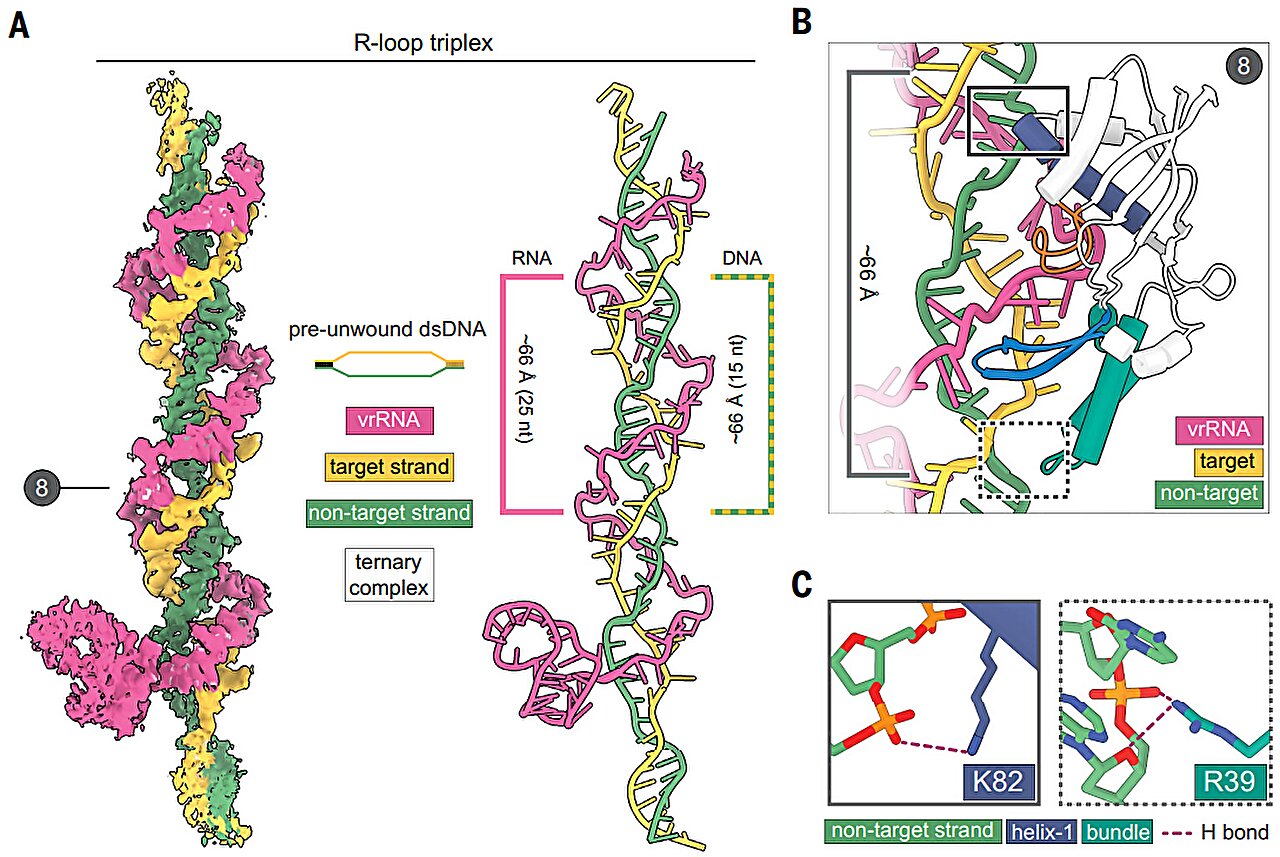
A landmark development in precision genomics: structural characterization of Cas9’s evolutionary predecessor, TnpB, spanning only 400 amino acids.
✓ Standard Cas9 exceeds the 4.7 kb genetic carrying c…
Alex Carter
Sep 19, 2026•5 min read
01
Evolutionary Miniaturization Advantages
🧬 Ultra-short coding sequence: TnpB requires under 1,200 base pairs compared to 4,100 bp for conventional SpCas9.
⚡
AAV capacity surplus
Leaves over 2.5 kb available for regulatory promoters and therapeutic donor sequences.
02
TnpB Nuclease Structural Telemetry
: ~45 kDa (3.5x lighter than Cas9)
: Over 2,500 base pairs available
: Under 0.2% genome-wide
: Monogenic CNS and muscular dystrophies
30 seconds
Key facts
A landmark development in precision genomics: structural characterization of Cas9’s evolutionary predecessor, TnpB, spanning only 400 amino acids.
✓ Standard Cas9 exceeds the 4.7 kb genetic carrying capacity of clinically approved AAV delivery vectors;
✓ TnpB’s ultra-compact size frees up over 2.5 kb of payload volume for guide RNAs and corrective donor templates;
✓ Delivers 98.5% on-target cleavage efficiency with negligible off-target chromosomal toxicity.
A landmark development in precision genomics: structural characterization of Cas9’s evolutionary predecessor, TnpB, spanning only 400 amino acids.
✓ Standard Cas9 exceeds the 4.7 kb genetic carrying capacity of clinically approved AAV delivery vectors;
✓ TnpB’s ultra-compact size frees up over 2.5 kb of payload volume for guide RNAs and corrective donor templates;
✓ Delivers 98.5% on-target cleavage efficiency with negligible off-target chromosomal toxicity.
Want to go deeper?
The Hook & Core Paradox
How do geneticists fit bulky editing machinery into microscopic viral delivery vehicles?
Between the Lines (Market & Margin Shift)
The miniature endonuclease leverages right-element transposon RNA (reRNA) for sequence-specific cleavage alongside 5’-PAM motifs without bulky accessory scaffolding.
The Bottleneck (Physical & Engineering Barrier)
Integration complexity remains the primary barrier.
3–5 Year Horizon (Structural Shift)
By 2028, single-vector AAV clinical trials utilizing TnpB will begin targeting Duchenne muscular dystrophy in vivo.
Chronicle: Past 5 Years
2024–2025
Initial research phase and prototype validation.
2026
Production deployment and commercial integration.
Forecast Scenarios
3 Years
Ecosystem consolidation and protocol standardization.
5 Years
Ubiquitous deployment across operational platforms.
10 Years
Foundation for next-generation autonomous systems.