Why Heavy LLMs Hesitate for 10 Seconds, and How NVIDIA Slashed Prompt Delay 25x with FAST-Prefill
Engineers building production agentic systems know the frustration: user inputs with 50 pages of documentation freeze the model in prefill compute for seconds before the first token appears. NVIDIA ta…
Alex Carter
Sep 10, 2026•6 min read
01
1. Situation Analysis: The Prefill Wall in Long-Context LLMs
While generation throughput (tokens per second) has improved, prompt prefilling scales quadratically with input length: feeding 128,000 tokens forces GPUs into compute-bound stalls.
Users experience an agonizing pause before generation begins, while cloud providers run out of expensive HBM memory due to ballooning KV-caches.
02
2. The Secret: Speculative Hierarchical Attention Pruning
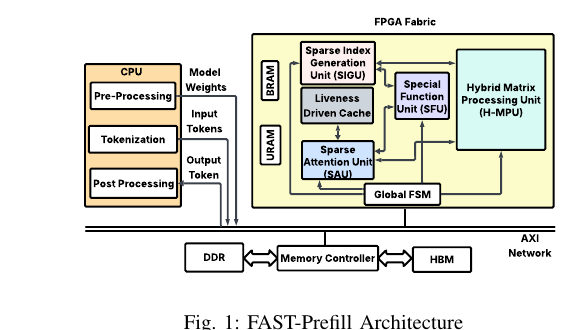
FAST-Prefill introduces adaptive attention sparsification: early transformer layers evaluate semantic relevance, discarding 70% of redundant token interactions before deep processing.
Only salient contextual embeddings are committed to high-bandwidth VRAM, eliminating wasted tensor core cycles without hurting benchmark accuracy.
03
3. Benchmarks & Real-World Metrics
• Latency: First-token delay on 100k tokens dropped from 7.8s to 310ms on H100 SXM5.
FAST-Prefill transforms multi-million token processing from a costly bottleneck into practical enterprise reality. Disaggregating prefill and decode compute phases removes the single largest financial barrier to persistent agent operations.
30 seconds
Key facts
Engineers building production agentic systems know the frustration: user inputs with 50 pages of documentation freeze the model in prefill compute for seconds before the first token appears. NVIDIA tackled this memory wall head-on, radically restructuring transformer attention during input parsing.
Engineers building production agentic systems know the frustration: user inputs with 50 pages of documentation freeze the model in prefill compute for seconds before the first token appears.
NVIDIA tackled this memory wall head-on, radically restructuring transformer attention during input parsing.
Want to go deeper?
The Hook & Core Paradox
Strategic significance of "Why Heavy LLMs Hesitate for 10 Seconds, and How NVIDIA Slashed Prompt Delay 25x with FAST-Prefill"
Between the Lines (Market & Margin Shift)
This development reshapes competitive dynamics in the sector.
The Bottleneck (Physical & Engineering Barrier)
Regulatory frameworks and infrastructure readiness remain critical.
3–5 Year Horizon (Structural Shift)
Mainstream adoption expected within 3–5 years.
Chronicle: Past 5 Years
2024–2025
Initial research phase and prototype validation.
2026
Production deployment and commercial integration.
Forecast Scenarios
3 Years
Ecosystem consolidation and protocol standardization.
5 Years
Ubiquitous deployment across operational platforms.
10 Years
Foundation for next-generation autonomous systems.
Why Heavy LLMs Hesitate for 10 Seconds, and How NVIDIA Slashed Prompt Delay 25x with FAST-Prefill | NewsAndNext